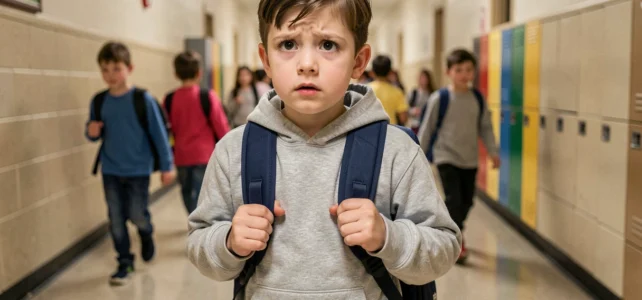
Didaskaleinophobia refers to an intense and persistent fear related to school. This term, less common than “school phobia,” encompasses a clinical reality that specialists are increasingly reformulating today. Vocabulary evolves, as do care systems, but the disorder remains poorly identified by many families.
Anxious school refusal: why the term “school phobia” is no longer sufficient
Clinicians and international researchers are increasingly favoring the concept of anxious school refusal (or EBSA, for Emotionally Based School Avoidance). This terminological shift reflects a better understanding of the mechanisms at play.
Didaskaleinophobia, in the strict sense, suggests that school itself is the object of fear. In reality, school often serves as a place of expression for distress with multiple roots: separation anxiety, social anxiety, bullying, neurodevelopmental disorders. Reducing the problem to a “phobia of school” directs responses solely towards the school environment, while care often needs to target broader anxiety disorders.
To learn everything about didaskaleinophobia, this distinction between fear of school and anxious school refusal serves as a useful starting point before initiating any process.
This reclassification is not merely a semantic debate. It concretely alters the diagnosis: a child labeled as “school phobic” risks missing out on a neurodevelopmental assessment or treatment for social anxiety. School is the site of the symptom, rarely its sole cause.
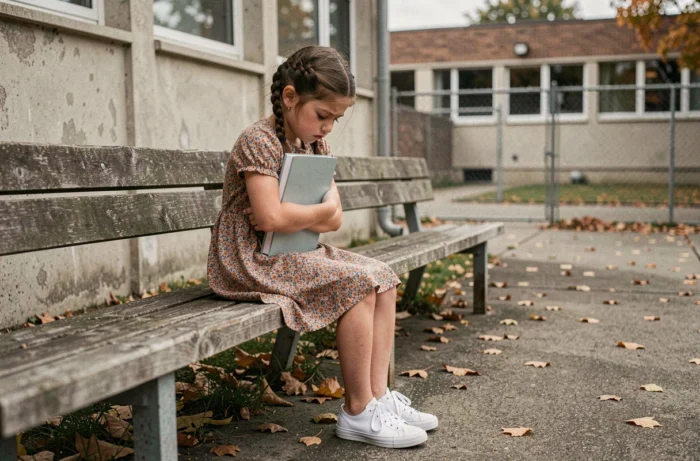
Warning signs in children: beyond stomach aches
The most well-known manifestations (stomach aches, nausea, crying at departure time) represent only part of the picture. Several less obvious signals deserve parents’ attention.
- A sudden change in behavior on Sunday evening or the night before a school day, characterized by irritability, tantrums, or silent withdrawal.
- Recurring somatic complaints that disappear during vacations or weekends, then return with almost mechanical regularity.
- A gradual avoidance of social activities outside of school (birthdays, outings with friends), indicating social anxiety extending beyond the school context.
- Recently emerged sleep difficulties, with no other identifiable cause.
In adolescents, refusal may take less visible forms: repeated tardiness, physical presence in class but complete cognitive disengagement, or exhausting daily negotiations with parents. The absence of a spectacular crisis does not mean the absence of suffering.
A common trap is to interpret these signs as laziness or a whim. Field reports diverge on this point: some teachers quickly identify distress, while others confuse it with a discipline problem. This misreading delays care, sometimes by several months.
APADHE system and gradual reschooling: the current framework
The updated guide from the National Education on home, hospital, or school pedagogical support (APADHE) establishes a framework for children experiencing anxious school refusal. Several principles structure this system.
The stated priority is to maintain the link with the school, even when the child cannot attend classes. Adjustments are planned: reduced timetable, partial attendance, temporary home schooling. The goal remains a gradual reschooling, not a permanent withdrawal.
However, actual access to these adjustments heavily depends on the institution and the academy. Not all parents are aware of the existence of the APADHE system, and the implementation timelines can be lengthy. The gap between the official framework and the reality experienced by families remains significant.
Individualized welcome project and the role of the school doctor
An individualized welcome project (PAI) can formalize the adjustments. The school doctor plays a coordinating role between the family, the educational team, and external health professionals. In practice, the burden of coordination often falls back on the parents themselves.
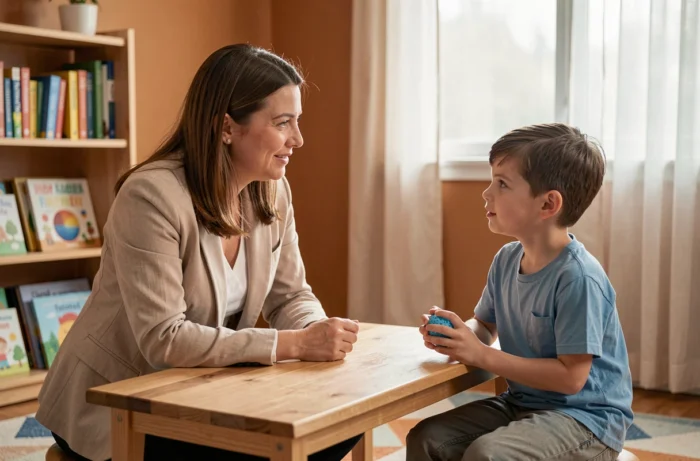
School phobia and associated disorders: what the assessment should explore
A child who refuses school rarely presents an isolated disorder. The available data do not allow for a conclusion on a typical profile, but several associations frequently appear in clinical literature.
Separation anxiety, often identified in younger children, regularly coexists with social anxiety or generalized anxiety disorder. In adolescents, depressive episodes sometimes accompany school refusal, without it always being clear which precedes the other.
Neurodevelopmental disorders (autism spectrum disorder, ADHD, learning disabilities) constitute an underestimated vulnerability factor. A child whose learning difficulties are not recognized may develop increasing anxiety in response to academic demands, up to the breaking point.
- A comprehensive psychological assessment, including an evaluation of cognitive functions, helps distinguish primary anxiety from secondary anxiety due to an undiagnosed disorder.
- The evaluation of social interactions allows for the detection of ongoing bullying, sometimes denied by the child themselves.
- Pediatric psychiatric follow-up proves relevant when physical symptoms (chronic pain, sleep disorders) persist beyond a few weeks.
An incomplete assessment leads to partial care, focused on the school symptom without addressing the underlying disorder. Relapse then becomes likely at each school year start or environmental change.
Family support in the face of school anxiety: adjusting one’s posture
Parental attitude towards school refusal impacts the evolution of the disorder. Two symmetrical pitfalls exist: forcing the child to attend class without considering their distress, or validating avoidance by deschooling them without a framework.
Current therapeutic approaches emphasize a gradual and supported exposure. The child reconnects with school in stages, with parallel psychological support. The pace depends on each situation, and attempts at abrupt reschooling after a long absence frequently result in failure.
The discourse held about school at home also matters. A parent who openly expresses distrust towards the school institution conveys, even unintentionally, a signal of insecurity. The child picks up on these non-verbal messages with remarkable sensitivity.
The most effective care remains that which involves the child, the family, the educational team, and a mental health professional in a coordinated approach. When one of these actors is missing, the system loses coherence and progress stagnates.