A pregnant woman arriving at the emergency room for a contraction at five months when she has not yet seen a midwife: we encounter this case more often than we think. Pregnancy monitoring is not just about ticking off appointments on a calendar. Each consultation, each examination has a specific objective, and missing them exposes one to avoidable complications.
Understanding what happens at each stage allows for a more serene experience during these nine months, both for the baby’s health and for that of the future mother.
Physical activity during pregnancy: recent recommendations change the game
Pregnant women are often advised to “move a little” without further precision. Recent French guidelines go much further. The Haute Autorité de Santé and the Assurance Maladie recommend, for uncomplicated pregnancies, 150 to 180 minutes of moderate physical activity per week, spread over at least three days.
Each session should not exceed 60 to 90 minutes, including warm-up and cool-down. This volume may be surprising, but it is based on solid data included in the updated guidelines from 2025-2026.
The often overlooked point: muscle strengthening is an integral part of the protocol. We are talking about core and pelvic floor work, not just walking or swimming. To gauge effort without a heart rate monitor, we use the “talk test”: if the pregnant woman can hold a conversation during exercise, the intensity is appropriate. If she is breathless to the point of being unable to speak, she needs to slow down.
Detailed information on each trimester is available on the portal site portaildelasante.fr pregnancy, which gathers practical sheets by stage of pregnancy.
Pregnancy declaration and first prenatal examination: what happens before the end of the third month
The first medical consultation must take place before the end of the third month of pregnancy. This is not just a simple administrative formality. The doctor or midwife conducts a complete clinical examination and prescribes a series of tests.
Specifically, during this appointment, the pregnancy is declared to the Assurance Maladie. With the Vitale card, the healthcare professional transmits the declaration directly to the Assurance Maladie fund and to the CAF or MSA. This declaration opens access to coverage for examinations and may trigger the payment of the birth grant under certain income conditions.
Prescriptions from the first appointment
From this consultation, several tests are prescribed:
- Determination of blood type and screening for irregular agglutinins, to anticipate any incompatibility
- Infectious disease screenings (toxoplasmosis, rubella, hepatitis B) and regular urine analyses
- An early prenatal interview, now mandatory, which allows for assessing the specific support needs of each woman
This early prenatal interview is not a standard medical examination. It serves to identify situations of vulnerability, social or psychological difficulties, and to guide towards appropriate support if necessary.
Seven mandatory prenatal consultations: understanding the follow-up calendar
After the first consultation, six other prenatal examinations are scheduled at a rate of one per month. All are fully covered by the Assurance Maladie. Each has its own objective according to the progression of the pregnancy: monitoring weight gain, checking blood pressure, measuring uterine height, listening to the baby’s heartbeat.
Feedback varies on this point, but some women find the monthly rhythm constraining, especially in rural areas where waiting times for an appointment with a gynecologist are increasing. The liberal midwife is authorized to ensure the entirety of the follow-up for a physiological pregnancy, which constitutes a concrete alternative.
Ultrasounds: three key appointments
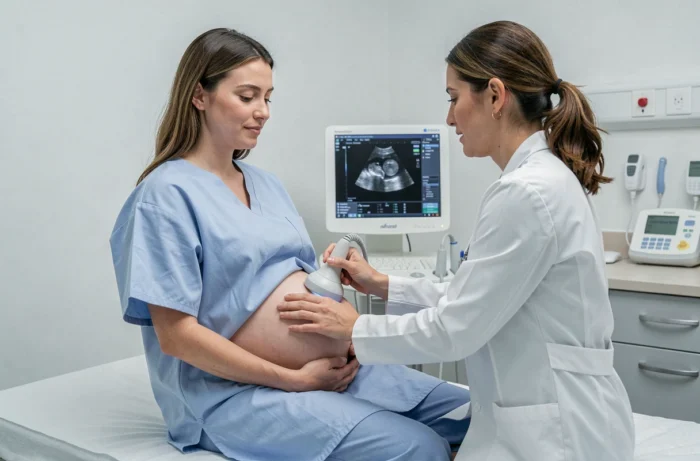
Alongside the monthly consultations, three ultrasounds are recommended, one per trimester. The first, around the twelfth week, confirms the dating and checks the number of embryos. The second, known as the morphological ultrasound, performed in the second trimester, reviews the baby’s organs. The third assesses its position and growth before delivery.

Perinatal mental health: a long-neglected aspect of pregnancy monitoring
There is much talk about nutrition and ultrasounds, but the mental health of future mothers remains undervalued in the standard pathway. Prenatal depression affects a significant number of pregnant women, and postpartum depression can manifest in the weeks following birth.
Systems are evolving. The parenting pathway now includes a mental health component, and the early prenatal interview has been specifically designed to open the discussion on psychological well-being. If a pregnant woman experiences persistent sadness, overwhelming anxiety, or unusual detachment, discussing it with the professional overseeing her care is the first step.
Maternity professionals are trained to recognize the warning signs of puerperal psychosis, a rare but serious psychiatric emergency that occurs in the days following childbirth. Knowing these warning signs, even in a basic way, helps those around to react quickly.
Nutrition and pregnancy: beyond food prohibitions
Lists of forbidden foods circulate everywhere. It is known that certain raw milk cheeses, artisanal charcuterie, or raw fish should be avoided. What deserves more attention are the nutrients whose needs actually increase during pregnancy.
- Folic acid, recommended from three months before conception and during the first trimester, contributes to the formation of the baby’s nervous system and reduces the risk of malformation
- Iron and calcium needs increase, especially in the second and third trimesters, when the baby’s growth accelerates
- Vitamin D, often deficient in France due to low winter sunlight, is subject to almost systematic supplementation
Taking prenatal multivitamins containing folic acid is advised, but it does not replace a varied diet. Nutritional follow-up with a midwife or doctor allows for adapting intakes on a case-by-case basis.
Pregnancy monitoring involves several professionals, regular examinations, and particular attention to both the body and psychological state. Each missed consultation is a closed window for screening. Making an appointment early, asking questions openly, and accepting the proposed support remain the three most useful reflexes for these nine months.