
Mass concentration relates the mass of solute to the total volume of solution. Volumetric concentration, on the other hand, relates a volume of solute to the volume of solution. These two quantities correspond to distinct experimental situations, and confusing them skews the entire calculation chain, from preparation to measurement.
Truncation Errors and Uncertainty Propagation in Concentration Calculation
A point rarely addressed in traditional courses: the management of significant figures when calculating C = m/V. Rounding the mass or volume before division propagates a relative error that can exceed the acceptable threshold in quantitative analysis.
We recommend maintaining at least one more significant figure than the precision of the measuring instrument throughout the calculation chain, then rounding only the final result. On a balance displaying the hundredth of a gram and a class A volumetric flask, the cumulative relative uncertainty guides the number of decimal places in the result.
The other pitfall concerns the intermediate unit. Converting milligrams to grams before division, or milliliters to liters afterward, generates forgotten factors of 103. Setting up the formula with units in columns, solute in the numerator and solution in the denominator, remains the most reliable safeguard. It is also useful to calculate mass or volumetric concentration by systematically comparing the two expressions to verify the dimensional consistency of the result.
Mass Concentration Formula: C = m/V in Real Conditions
The formula C = msolute / Vsolution gives the mass concentration in g/L. It applies when the solute is weighed (solid, powder, lyophilisate) and dissolved in a liquid solvent.

In practice, the volume of solution is not the volume of solvent. Dissolving a salt in water changes the total volume. For a volumetric flask, one fills to the mark after dissolution. For a beaker, the measured volume after dissolution already includes the contribution of the solute.
Dilution Case
During a dilution, the relationship C1V1 = C2V2 is based on the conservation of the mass of solute. This equality assumes that the volumes are additive, which is only approximately true for dilute solutions. For concentrated solutions (strong acids, brines), the additivity of volumes is no longer guaranteed, and the density of the solution must be taken into account.
We frequently observe this error in the preparation of standard solutions: using the dilution formula without checking the density of the stock solution leads to a systematic bias in the daughter concentration.
Volumetric Concentration: When the Solute is a Miscible Liquid
Volumetric concentration, expressed in mL/L or as a volumetric percentage (% v/v), is used when both solute and solvent are liquids. Ethanol in water, a flavoring in an oily base, a liquid reagent in an organic solvent: in each case, the volume of pure solute is reported to the total volume of solution.
The volumetric percentage does not account for volume contraction upon mixing. Mixing 50 mL of ethanol and 50 mL of water does not yield 100 mL of solution but a slightly lower volume. This phenomenon, related to molecular interactions between solute and solvent, introduces a discrepancy between the theoretical volumetric concentration and the actual concentration.
Mass Percentage versus Volumetric Percentage
The choice between % m/m, % m/v, and % v/v depends on regulatory use and the type of solute:
- The % m/m (mass of solute over mass of solution) is preferred in pharmacopoeia and safety data sheets, as it does not vary with temperature
- The % m/v (mass of solute over volume of solution) is common in clinical biology and analytical chemistry, as volume is easier to measure than weighing a solution
- The % v/v is reserved for liquid-liquid mixtures, particularly for the alcoholic titration of beverages or industrial solvents
In Europe, the revision of the CLP regulation introduces new hazard classes (endocrine disruptors, PBT and PMT substances) with trigger concentration thresholds expressed in mass percentage. In the United States, the revised HazCom standard in 2024 now imposes thirteen predefined concentration ranges in SDS when the exact value is confidential. These regulatory constraints make mastering the conversion between concentration units necessary.
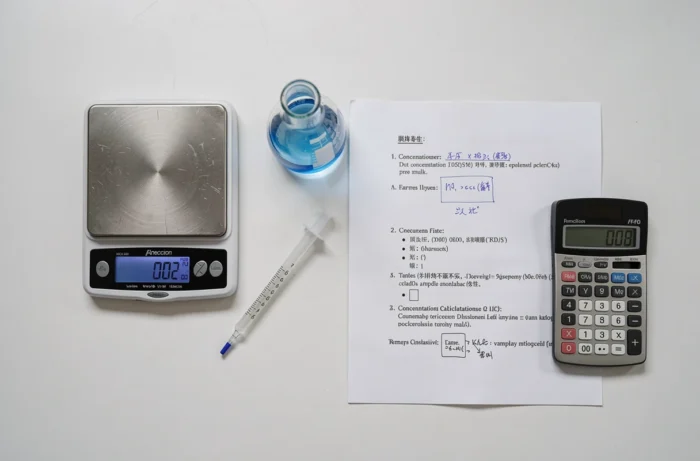
Converting Mass Concentration and Molar Concentration
The transition from mass concentration C (in g/L) to molar concentration c (in mol/L) uses the molar mass M of the solute: c = C / M. This conversion assumes that the molar mass is known precisely, which poses problems for polymers, proteins, or mixtures of variable composition.
For a pure solute with a known molecular formula, the conversion is direct. For a natural extract or a technical mixture, we recommend staying in mass concentration and converting to mol/L only if the stoichiometry of a reaction requires it.
Summary Table of Formulas
| Quantity | Formula | Common Unit |
|---|---|---|
| Mass Concentration | C = msolute / Vsolution | g/L |
| Molar Concentration | c = nsolute / Vsolution | mol/L |
| Mass to Molar Conversion | c = C / M | mol/L |
| % Mass (m/m) | ω = msolute / msolution × 100 | % |
| % Volumetric (v/v) | φ = Vsolute / Vsolution × 100 | % |
The table above covers the most common cases in analytical chemistry, formulation, and quality control. Each formula is based on an assumption (additivity of volumes, homogeneity of the solution, fixed temperature) that must be verified before applying the calculation.
Attention to units, consideration of density for concentrated solutions, and the choice of the appropriate type of percentage for the regulatory context remain the three points where the reliability of a concentration result is determined. Mastering these aspects avoids dosing errors whose consequences, in the laboratory as well as in production, can be significant.