
Some people do not identify as either male or female, nor even as a mix of both. They simply describe an absence of gender. The term agender specifically refers to this experience: feeling no belonging to a gender category. Far from being a trend, this identity questions how our societies classify individuals from birth.
Gender identity and assigned sex: two distinct realities
Before discussing agender, one point deserves clarification. The sex assigned at birth (male, female, or intersex) is based on biological characteristics. Gender identity, on the other hand, pertains to personal feelings.
A person may be assigned male at birth and feel perfectly aligned with that category. Another, assigned female, identifies as male. And some people do not fit into either of these boxes. Gender identity does not depend on anatomy.
Understanding the meaning of the term agender requires acknowledging that gender is not a binary switch, but a spectrum that also includes the possibility of feeling nothing at all in this regard.
Agender: precise definition and concrete experience
An agender person (or agenre, in French) does not identify with any gender. Not male, not female, not a mix, not a third gender. The prefix “a-” means “without,” as in “apolitical” or “asymptomatic.”
You may be wondering what this changes in daily life? For many agender individuals, their relationship with gender resembles a question that does not arise. Where others feel a strong belonging to a gender, an agender person often describes a void, indifference, or detachment regarding this notion.

Being agender does not mean rejecting others or refusing society. It is an intimate feeling that varies from person to person. Two agender individuals may experience this identity very differently: one may adopt an androgynous appearance, while the other wears clothing associated with a gender without contradicting their identity.
Common confusions to avoid
Agender is often confused with other terms. Here are the distinctions to remember:
- Agender and non-binary: the term non-binary encompasses all identities that are not limited to male or female. Agender is part of this, but non-binary does not necessarily mean agender. A bigender or genderfluid person is also non-binary.
- Agender and asexual: one concerns gender identity, the other sexual orientation. An agender person may experience sexual or romantic attraction, regardless of its nature.
- Agender and androgynous: androgyny describes a physical appearance or style that mixes masculine and feminine codes. It is a matter of expression, not internal identity.
Administrative recognition of genderless individuals
Can one live without a gender in a world that requires checking “M” or “F” everywhere? This question is not abstract; it arises with every administrative form, every border crossing, every registration.
In Germany, a gender marker “diverse” and the option “no indication” have been officially available since December 2018. Recent data shows a significant increase in individuals registered under these categories, with nearly tripling since 2022. This legal framework provides concrete recognition for agender individuals.
In France, the situation is different. The civil registry does not offer a third gender option. The national plan for equality against anti-LGBTI hate and discrimination 2026-2029, launched by DILCRAH, includes actions on inclusion, but the question of a neutral administrative marker remains open.
In the United Kingdom, recent case law links the terms “woman” and “man” to biological sex within the framework of the Equality Act, while maintaining protection against discrimination for trans individuals. Inclusion policies must navigate trade-offs between protection and institutional security.
Agender and social life: what really changes
Beyond rights, living as an agender person involves navigating a world built around gender. Pronouns are a good example.
In English, the singular pronoun “they” has become widely used to refer to a person without a defined gender. In French, the language offers less flexibility. Some agender individuals use the pronoun “iel,” others prefer to alternate between “il” and “elle,” while others do not express a marked preference.
Agender identity in adolescents
The construction of gender identity particularly refines during adolescence. Research in developmental psychology shows that this period is crucial for gender exploration. Adolescents who identify as agender go through an identification process similar to that of any adolescent, with one additional variable: the vocabulary to describe their experiences has only recently emerged in the public space.
Naming one’s identity is often the first step to understanding it. The dissemination of terms like agender, non-binary, or genderfluid in media and social networks provides a reference framework that previous generations lacked.
Pronouns, expression, and identity: three dimensions not to be confused
One last structuring point. Gender identity (how one perceives oneself), gender expression (how one presents oneself to the world), and the pronouns used are not always aligned in predictable ways.
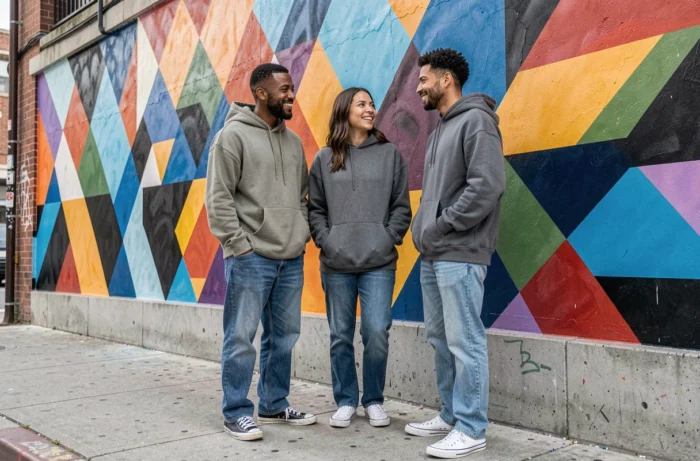
An agender person may have a beard and wear dresses. Another may have a very conventional appearance. The absence of gender does not dictate any dress code or social rule.
This gap between identity and appearance can sometimes confuse those around. The key remains simple: ask a person how they wish to be referred to, without assuming anything based on their appearance.
The agender identity reminds us that gender, no matter how omnipresent it is in our social structures, is not a necessary path for every individual. Administrative advancements in some countries and the dissemination of vocabulary in the public space contribute to making this reality more visible, without resolving the concrete frictions of daily life.