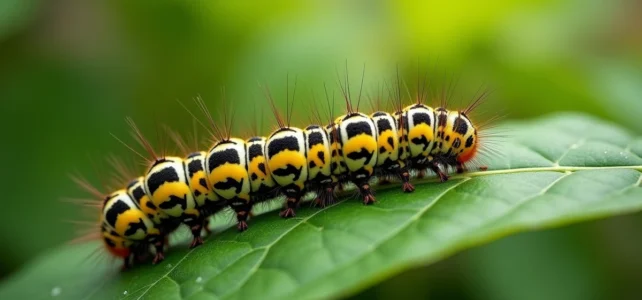
A yellow and black caterpillar on a rosebush does not elicit the same reaction as a gray caterpillar on a pine tree. The yellow color, whether associated with black or not, almost rules out the diagnosis of processionary caterpillars, whose larvae are never yellow or green. Before treating, we recommend making a precise diagnosis based on the host plant and the morphology of the larva, not just on the color palette.
True caterpillar or false caterpillar: counting the false legs changes everything
The first mistake in identification is to group under the term “caterpillar” larvae that do not belong to the same order. A true Lepidoptera caterpillar has at most five pairs of false abdominal legs. A sawfly larva (Hymenoptera), often yellow and black on rosebush or willow, has six pairs or more.
This distinction is not academic. Bacillus thuringiensis kurstaki (Btk), the reference biological treatment against butterfly caterpillars, is completely ineffective on sawflies. Spraying Btk on a false sawfly caterpillar is a waste of product while allowing the damage to progress.
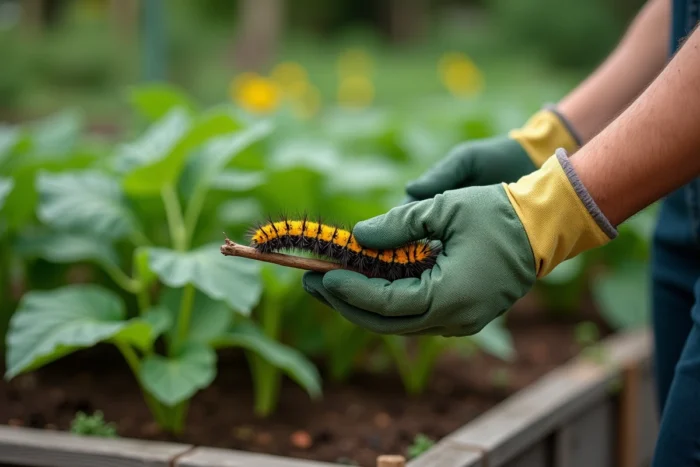
To count the false legs, gently turn the larva over: the true thoracic legs (three pairs, at the front) are articulated and dark, while the false abdominal legs are fleshy, without articulation. On a yellow and black sawfly larva on a rosebush, you will count six to eight pairs, which clearly distinguishes the diagnosis. To reliably identify a yellow and black caterpillar, this morphological criterion takes precedence over color.
Host plant and hairiness: the duo that guides the diagnosis
The yellow and black color is found in very different species. Relying solely on the color pattern leads to systematic confusion. We observe that the host plant is the most discriminating criterion to narrow down the list of suspects.
Yellow and black caterpillars on Brassicaceae
On cabbage, rapeseed, or mustard, the cabbage butterfly (Pieris brassicae) in the larval stage displays a yellow-green body striped with black, with short sparse hairs. It appears hairless compared to processionary caterpillars. The damage is rapid: a colony can skeletonize a cabbage in a few days.
Yellow and black caterpillars on Apiaceae
On carrot, fennel, or parsley, the caterpillar of the swallowtail (Papilio machaon) has black bands and orange spots on a green-yellow background. It is completely hairless, with no stinging hairs. This protected species in several regions does not warrant any treatment: we recommend manually relocating it if its presence hinders cultivation.
Yellow and black caterpillars on rosebushes and willows
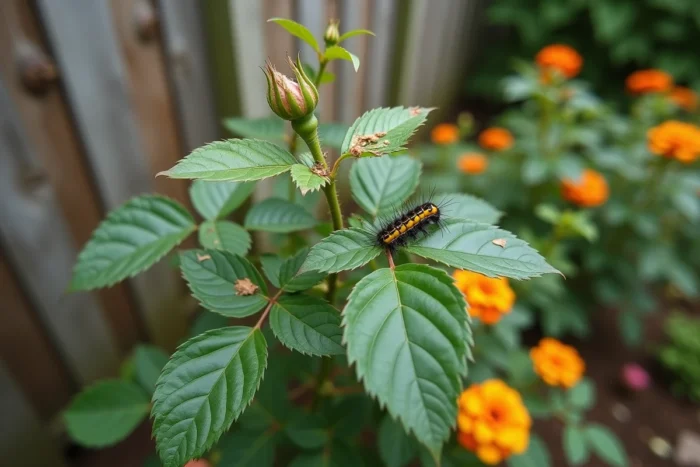
Sawfly larvae (false caterpillars, as explained above) are common on these plants. They can be recognized by their S-shaped curled posture when disturbed and by their complete lack of hairiness.
The combination of host plant and hairiness allows for an assessment of the danger to the gardener:
- Hairy caterpillar on pine or oak, gray to brown, in procession: suspicion of processionary caterpillar, do not touch
- Hairless yellow and black caterpillar on Brassicaceae or Apiaceae: potential pest of the vegetable garden, non-stinging
- Hairless yellow and black larva with six or more pairs of false legs on rosebush: sawfly, specific treatment necessary
Protecting the garden without destroying biodiversity
Yellow and black caterpillars are almost never stinging. The temptation to spray a broad-spectrum insecticide is counterproductive: it also eliminates beneficial insects (hoverflies, lacewings, parasitoids) that naturally regulate pest populations.
Btk: effective but only on Lepidoptera
Bacillus thuringiensis kurstaki acts by ingestion on butterfly caterpillars. It should be sprayed on the affected foliage, preferably in the late afternoon to limit degradation by UV light. On cabbage butterfly, the effectiveness is good provided you intervene early, when the larvae are less than one centimeter long.
On sawflies, Btk does not work. For these false caterpillars, the nematode Steinernema feltiae is a biological alternative that can be applied by spraying on moist foliage.
Targeted preventive methods
Rather than treating reactively, several strategies reduce larval pressure without chemical intervention:
- Insect-proof nets on Brassicaceae from planting, to prevent the cabbage butterfly from laying eggs
- Crop rotation in the vegetable garden, which disrupts the development cycle of species tied to a plant family
- Maintaining diverse hedges to encourage insectivorous birds (tits, warblers) and parasitoid wasps
- Manual collection of visible larvae, effective on small areas and without collateral effects
Yellow and black caterpillar on pine or oak: the only case of health alert
The processionary caterpillars of pine and oak are neither yellow nor green. Their larvae display a gray-brown body with a dark back, covered with microscopic stinging hairs (setae) that detach into the air and cause allergic reactions, skin irritations, and respiratory issues.
If you find a distinctly yellow and black caterpillar on a pine or oak, the likelihood that it is a processionary caterpillar is very low. Check for the presence of characteristic white silky nests and the behavior of moving in a line. In their absence, you are dealing with another species.
In case of doubt about a conifer, do not handle the caterpillar. The stinging hairs remain active even on abandoned nests or molts. Call a professional equipped to remove processionary nests.
The most useful reflex when facing a yellow and black caterpillar is to avoid acting in haste. Identify the plant, count the false legs, assess the hairiness: these three actions are sufficient to guide the diagnosis and choose the right response, whether it is to protect a beneficial species or to treat a pest with the appropriate product.