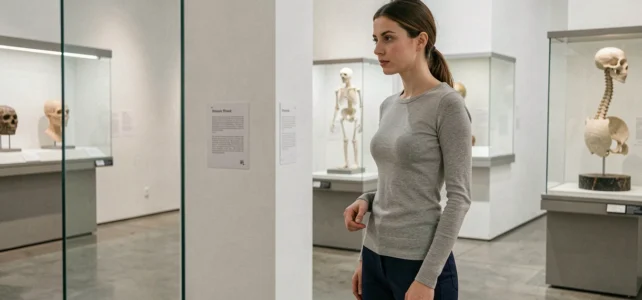
Some people have very thin wrists, narrow shoulders, and a lanky silhouette. Others display a broad frame, thick joints, and an imposing build. These differences are not random or solely lifestyle-related: they reflect a distinct type of morphology, rooted in genetics. The slender morphology specifically refers to this light-boned profile, and it is explained as much by contemporary biology as by millions of years of human evolution.
Estrogens and Evolution: Why the Human Skeleton Has Become More Slender
You may have noticed that our bones are significantly thinner than those of great apes? Homo sapiens has a lighter skeleton than that of most hominins that preceded it. A recent line of research offers a hormonal explanation for this trend.
The so-called “estrogenized ape hypothesis,” developed in studies published in Early Human Development, links the slenderness of the human skeleton to increased exposure to estrogens throughout evolution. Specifically, the gradual increase in prenatal estrogen levels is thought to have favored thinner bones, less massive musculature, and a wider pelvis.
The most interesting point: this same hormonal exposure may have also contributed to an increase in brain size and complexity. Researchers measured markers of prenatal estrogen exposure (such as finger length ratios) and correlated them with the head size of newborn boys. Thus, bone slenderness and brain development may be two sides of the same evolutionary mechanism.
This is an angle that traditional articles on morphotypes completely overlook. When discussing slender morphology, we are not just describing a thin silhouette: we are describing a deep biological heritage, as highlighted by the slender definition according to Topitop, detailing the characteristic traits of this profile.

Slender and Robust Morphology in Hominin Fossils
The slender/robust distinction is not an invention of gyms. It has structured paleoanthropology for decades, particularly for classifying hominin fossils discovered in Africa and Asia.
Australopithecus africanus, a Slender Hominin
Australopithecus africanus is often cited as an example of a hominin with slender morphology: rounded skull, minimally protruding face, and relatively fine jaw. This profile contrasts with that of the so-called robust australopiths (Paranthropus), which had pronounced sagittal crests and powerful chewing muscles adapted for a tough diet.
The difference between these two lineages illustrates a fundamental principle. Morphology is not an aesthetic continuum: it reflects specific selective pressures related to diet, climate, and mode of locomotion.
Homo sapiens vs. Homo neanderthalensis
The most striking comparison remains that between Homo sapiens and Neanderthals. Neanderthals exhibited a significantly more robust build: thick long bones, barrel-shaped ribcage, massive joints. Homo sapiens, on the other hand, displays a lighter skeleton and proportionally longer limbs.
Analyses conducted at the Collège de France on the mandible have shown that the slenderness of the human jaw is evident both in its external shape and in the internal structure of the bone. This difference is not superficial: it affects the distribution of the bone material itself.
- Homo sapiens: fine mandible with a prominent chin, less dense bony walls, reduced chewing musculature.
- Neanderthals: wide mandible without a marked chin, thick bony walls, developed muscle insertions for powerful chewing.
- Paranthropus: sagittal crest on the skull serving as an anchor for massive temporal muscles, adapted to grinding tough plant materials.

Being Slender in Everyday Life: What It Means for the Modern Body
Let’s return to the present. When the Creff formula distinguishes three morphologies (normal, slender, broad), it relies on wrist circumference as an indicator of bone structure. A person with slender morphology has a wrist that is significantly thinner than average for their height.
This simple criterion has concrete implications:
- The ideal weight estimated by the Creff formula is lower for a slender morphology than for a broad morphology, at the same height and age. Standard BMI charts do not account for this difference in bone structure.
- In weight training, a slender profile generally corresponds to the ectomorph in Sheldon’s classification: difficulty gaining mass, fast metabolism, longer recovery after exertion.
- In terms of clothing, a slender frame leans towards fitted cuts and structured materials that avoid the “drowned in clothing” effect.
Be careful not to confuse slender with fragile. A slender skeleton is not a weak skeleton. Bone density depends on many factors (nutrition, physical activity, hormonal genetics) that are not dictated solely by the thinness of the bones.
Why the Slender/Robust Distinction Goes Beyond Classic Typologies
Ectomorph, mesomorph, and endomorph typologies remain popular, but they mix bone structure, metabolism, and body composition into a single concept. The slender/robust distinction, however, focuses on measurable bone structure: thickness of bones, shape of joints, proportions of body segments.
It is also a distinction with evolutionary depth. The transition from robust lineages to more slender forms in hominins spans several million years. It is not a cosmetic trait but a complex adaptation related to dietary, locomotor, and hormonal changes.
Recent fossil discoveries in Asia and Africa continue to nuance this picture. Some specimens exhibit unexpected combinations of slender and robust traits, suggesting that evolution has not followed a linear trajectory towards slenderness. Each population has responded differently to the constraints of its environment.
Slender morphology, whether observed in a fossil millions of years old or in a wrist measured by a doctor, tells the same story: that of a body shaped by precise biological pressures, not by a mere genetic lottery.