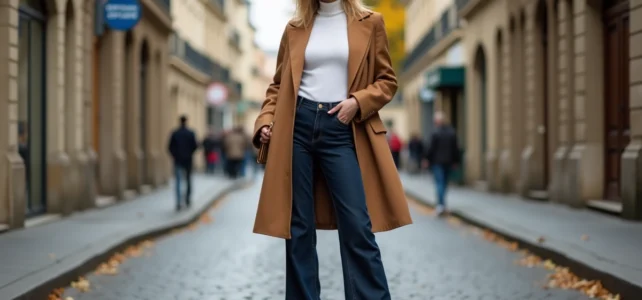
This season’s fashion trends create a wardrobe that’s more readable than one might think. Between the return of very identifiable pieces (raw denim, draping, large polka dots) and the rise of circular fashion driven by European regulatory frameworks, the signals converge towards clothing choices that are both bold and sustainable. Which style codes truly stand out, and on what criteria can they be distinguished?
Key Pieces and Style Codes: Comparative Table of the Season
Rather than listing dozens of micro-trends, the 2026 market is structured around a few strong pieces and precise aesthetic codes. Here is a cross-analysis of the confirmed trends on the runways and in search data.
| Piece or Code | Dominant Style | Seasonal Versatility | Sustainability Signal |
|---|---|---|---|
| Long Flowing Dress | Poetcore, embraced femininity | Spring-summer, adaptable for autumn with layering | Light materials, often linen or viscose |
| Structured Wide Pants | Casual chic, defined waist | All seasons depending on fabric | Timeless cut, low obsolescence |
| Raw Denim | Workwear, raw minimalism | Primarily autumn-winter, but worn year-round | Natural fiber, easy maintenance |
| Faux Fur Details | Textured maximalism | Autumn-winter | Depends on synthetic composition |
| Large Polka Dots / Statement Patterns | Graphic pop | Primarily spring-summer | Classic pattern, reusable from season to season |
| Structured Bags | Rigid chic, geometric lines | All seasons | Slow rotation accessory |
What stands out from this overview: pieces with strong visual identities are replacing generic minimalism. Draping, volumes, and marked textures are taking precedence over the neutral silhouettes that dominated in recent years.
Current fashion trends, regularly analyzed on Buzz du moment’s fashion page, confirm this shift towards more expressive clothing.
Raw Denim and Draping: Two Fashion Trends with Opposing Logics
Raw denim and draping both take center stage, but for very different reasons. Comparing them sheds light on how this season’s fashion operates through contrasts.
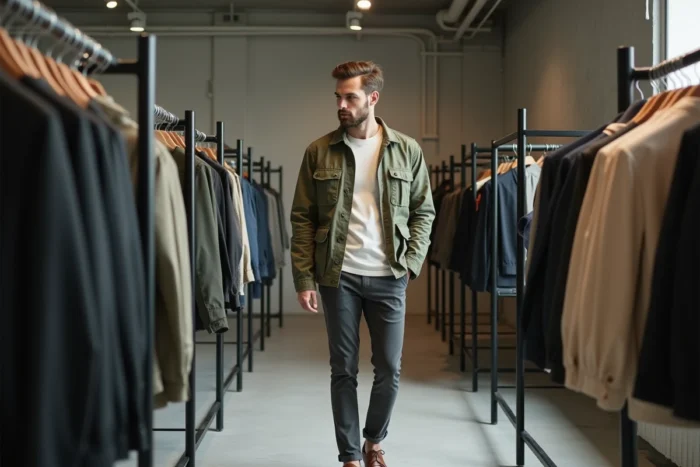
Raw denim fits into a workwear and sailor aesthetic that cyclically returns. Its strength lies in its simplicity: a thick, unwashed fabric that ages beautifully over time. It can be worn as barrel jeans, a short jacket, or a straight skirt. What changes this season is the pairing with bright colors (butter yellow, olive green) rather than with white or black.
Draping, on the other hand, plays on the opposite register. It focuses on the movement of the fabric rather than the rigidity of the cut. Flowing dresses, asymmetrical blouses, voluminous skirts: draping adds depth without apparent structure. On the runways of Milan and Paris, houses like Loewe and Saint Laurent have extensively utilized it in their spring-summer 2026 collections.
Combining These Two Registers in One Look
One of the style codes that works this season is mixing these two registers. Wearing raw denim pants with a draped viscose top creates a contrast of textures that adds character to an outfit without multiplying pieces.
This logic of textured layering between rigid and fluid materials is also reflected in accessorizing: a structured bag with a long dress, or a thin belt over a loose coordinated set.
Trend Colors: Saturated Intensity vs. Natural Tones
The Pinterest Predicts report, which analyzes social media searches to anticipate trends, highlights a polarized color palette this season. Two chromatic families coexist:
- Saturated and bold colors: orange, bright pink, butter yellow, sky blue. They dominate statement pieces (long dress, short jacket, voluminous skirt) and create an immediately identifiable look.
- Natural and muted tones: olive green, beige, ecru, brown. They prevail in structured pieces (wide pants, short trench, denim) and serve as a base for the rest of the outfit.
- Two-tone contrasts: wearing a single saturated piece against a neutral background remains the most readable formula. The total colorful look works on the runways but requires a mastery of proportions in everyday life.
Color acts as a stronger trend marker than the cut itself. A classic beige pant worn with a butter yellow sweater is enough to anchor a silhouette in the season without changing the wardrobe.
Circular Fashion and the Digital Textile Passport: What Changes for the Consumer
Beyond pieces and colors, the 2026 season marks a regulatory turning point that changes how clothing is produced and documented. In May 2026, the European Commission clarified the content of the digital passport for textile products: 49 pieces of information per product, with a level of detail down to the production batch. Mandatory rules are announced for the end of 2027, with practical implementation for spring-summer 2028 collections.
This timeline means that brands are already preparing their traceability systems. For the consumer, the direct consequence will be increased transparency regarding the composition, origin, and manufacturing conditions of each garment.
Textile EPR and the Maturity of Circular Fashion
According to KPMG, circular fashion is entering a phase of maturity in Europe due to the combined effects of extended producer responsibility (EPR) and transparency requirements. Brands must now provide proof of compliance regarding their product systems, not just display commitments.
To adopt a stylish look this season, this changes the game: prioritizing pieces with low obsolescence (raw denim, structured wide pants, rigid bag) aligns one’s style with an underlying market movement. Casual clothing and natural materials are gaining ground against ephemeral collections.
The 2026 clothing market remains driven by sustainability and digitization. Pieces that transcend multiple seasons without losing stylistic relevance, such as the long flowing dress or raw denim, concentrate both fashion value and utility value. Choosing fewer, better-identified pieces with bold colors on a neutral base: this is probably the most accurate reading of this season’s trends.