
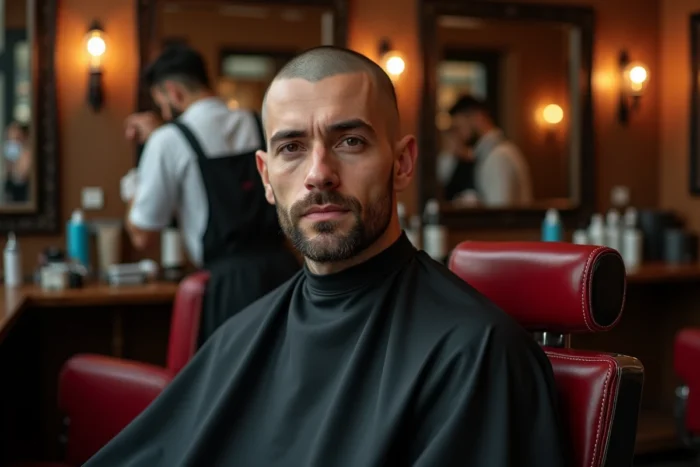
The shaved head exposes every bony relief, every skin irregularity, and every facial asymmetry. Before using the clippers, we recommend assessing three specific parameters: cranial morphology, scalp condition, and interaction with facial hair. These criteria matter much more than just the shape of the face, contrary to what most popular guides repeat.
Cranial Morphology and Irregularities: The True Criterion for a Shaved Head
The shape of the face (oval, round, square) is overrepresented in hair advice. In reality, it is the topography of the skull that determines the final result. An oval face with a flat occiput or a pronounced parietal bump will yield a disappointing result despite “ideal” facial proportions.
We observe that the most underestimated area is the back of the skull. Run your hand from the crown to the nape: a rounded and regular skull accepts a full shave without reservation. A noticeable flattening at the back creates an unbalanced profile, visible as soon as the length goes below one centimeter.
Scars, prominent moles, and dermal irregularities become dominant visual elements once the hair is removed. Before making any decisions, inspect your scalp under direct lighting. If you spot areas of uneven pigmentation or marked skin reliefs, a short buzz cut (grade 2 or 3) offers a more suitable compromise than a full shave.
To deepen this diagnosis, knowing how to know if a shaved head suits your morphology remains a crucial preliminary step not to be overlooked.

Shaved Head and Beard: The Duo That Balances the Face
Facial hair restructures proportions as much as the cut itself. A bare head shifts the visual center of gravity down the face. Without a beard, the ears, forehead, and jaw take on a disproportionate presence. With a well-groomed beard, the gaze is refocused.
On a round face, a pointed beard (Van Dyke style or elongated goatee) visually stretches the oval and compensates for the roundness accentuated by the lack of hair. On an angular or very bony face, a short and uniform beard softens the lines without adding harshness.
A common mistake is to let a full beard grow without maintenance, thinking that volume will automatically compensate. The result is the opposite: a clean-shaven head requires a beard with defined contours; otherwise, the contrast becomes neglected rather than structured. Defined cheek lines, shaved neck contour under the jaw, uniform length: these three points make the difference.
Special Case: Little or No Beard
Not being able to wear a beard does not disqualify a shaved head. However, other elements must then take over to structure the face. Well-defined eyebrows, prominent framed glasses, or a well-designed collar fulfill this function. The challenge is not to leave the face “naked” on all fronts simultaneously.
Buzz Cut or Full Shave: Choosing the Right Clipper Grade
The term “shaved head” covers very different realities depending on the grade used. This technical distinction radically changes the appearance and maintenance.
- Grade 0 (razor or clipper without guard): visible skin, smooth effect. Reveals all skin imperfections. Visible regrowth as early as the next day, requires maintenance every two to three days.
- Grade 1 to 2 (approximately 3 to 6 mm): leaves a hair shadow that softens the irregularities of the skull and pigmentation spots. A common compromise for those who are starting out or whose scalp has flaws.
- Grade 3 to 4 (approximately 9 to 12 mm): classic buzz cut, retains enough material to suggest a cut while remaining very short. Suitable for slightly irregular skulls and scalps sensitive to the sun.
We recommend starting with a grade 3, then gradually going down. A direct jump to grade 0 leaves no room for correction if the result is not satisfactory. Going down one grade per week allows for assessing each step without irreversible commitment.
Scalp Care After Shaving: Protection and Hydration
A shaved head exposes the scalp to UV rays, cold, and mechanical aggressions. This area, usually protected by hair, is not prepared for permanent direct exposure.
Daily hydration with a non-comedogenic product prevents dry patches and post-shave irritations. Balms made with shea butter or aloe vera work well, provided to avoid overly greasy formulas that make the scalp shine under artificial lighting.
Sun protection is the most neglected aspect of a shaved head. A minimum SPF 30 on the top of the head and ears becomes necessary as soon as exposure exceeds fifteen minutes. Sunburn on the scalp is particularly painful and can cause visible peeling for several days.
Shaving Frequency and Suitable Tools
Regrowth varies among individuals, but most shaved heads at grade 0 require a clipper or razor every two to three days to maintain a clean appearance. Beyond that, uneven regrowth (denser on the sides, sparser on top in cases of early baldness) creates an unflattering patchwork effect.
A specific rotary clipper for the head makes shaving the back areas easier without an additional mirror. Manual razors provide a smoother result but increase the risk of cuts and ingrown hairs, especially in areas where the skin has folds or moles.
A shaved head remains one of the most demanding cuts in terms of regular maintenance, despite its reputation for simplicity. A neglected shave is noticed more quickly than a poorly styled long cut, making it a daily commitment to fully embrace before taking the plunge.