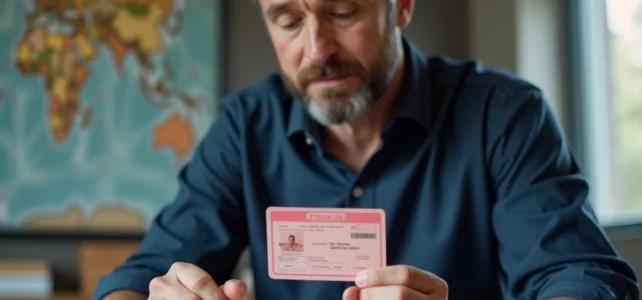
The pink license, this cardboard document with three sections issued in France for decades, remains legally valid on French territory until January 19, 2033. For drivers traveling abroad, the question of its use overseas is becoming increasingly urgent. On paper, the law recognizes this format throughout Europe. In practice, refusals at rental counters or hesitations during roadside checks remain common.
Vehicle Rentals and the Pink License: The Real Friction Point
The legal validity of the pink license abroad does not guarantee its commercial acceptance. The real issue lies with rental agencies.
In the United States and several countries outside Europe, rental agencies are increasingly refusing the three-section format. The cardboard document, lacking a secure photo or electronic chip, does not meet the identity verification standards that these companies apply. The license is legally valid, but the agent at the counter does not recognize it as a reliable document.
This phenomenon is also observed within the European Union. Feedback from travelers reports discussions or even refusals in Spain, Italy, or Greece, not for legal reasons, but because the cardboard format poses a readability issue. A worn pink license, partially faded, or with a barely visible photo logically triggers distrust.
To find information about the pink license abroad and anticipate these situations, it is better to prepare before departure rather than at the time of vehicle pickup.

Pink License in Europe: Legal Validity and the 185-Day Limit
In all countries of the European Union and the European Economic Area, the French license (regardless of its format) is recognized for a short stay. The rule is clear: as long as you stay less than 185 days per year in the concerned country, your pink license is sufficient to drive.
Three conditions must be met:
- The license must be valid and legible (identifiable categories, recognizable photo).
- Any medical prescriptions noted on the document must be respected, such as wearing glasses.
- The holder must not be subject to a suspension, restriction, or cancellation of their right to drive in France.
Beyond 185 days, you are considered a resident of the host country. At this stage, most states require an exchange for a local license. And this is where the pink format complicates matters: from abroad, ANTS procedures are often impossible for expatriates holding an old title.
International License: When is it Necessary Outside Europe?
Outside the EU and EEA, the recognition of the French license depends on the international agreements signed by each state. The Geneva (1949) and Vienna (1968) conventions on road traffic set the framework. A signatory country generally accepts any valid national license, sometimes accompanied by an international driving permit (IDP).
The IDP is a translation of the license into several languages. It does not replace the license; it complements it. For holders of a pink license, the IDP acts as a buffer: it provides a standardized document that local authorities and rental agencies can identify more easily.
Some common scenarios include:
- In the United States, the IDP is not legally required in most states, but it significantly reduces the risk of refusals at rental agencies.
- In some Southeast Asian or African countries, the French license alone is not sufficient, and the IDP is required during roadside checks.
The key takeaway: a pink license accompanied by an IDP remains usable in most countries, but the cardboard format alone, without translation, increases the risk of complications.
Expatriates and the Pink License: The Exchange Trap from Abroad
The most delicate situation concerns French citizens permanently residing outside France. Article R.221-1 of the Road Code requires residents of a foreign country to obtain a license issued by that state. Therefore, the French pink license cannot indefinitely serve as an alternative.
A parliamentary question posed by Senator Sophie Briante Guillemont highlighted an administrative blockage: French expatriates generally cannot carry out procedures related to their French license from abroad via ANTS. The exchange of the pink license for the new card format must, in principle, be done before departure or during a visit to France.
For expatriates in a country that has signed a reciprocal exchange agreement with France, the procedure is simpler: the pink license can be exchanged locally for a title from the country of residence. In countries without a bilateral agreement, reapplying for the local license remains the only option.

Anticipating the Exchange Before 2033: A Matter of Comfort More Than Urgency
Why Not Wait Until the Last Year?
The pink license remains legally valid until January 19, 2033. There is no obligation for immediate replacement. The practical difficulties described above (refusal of rental, checks abroad, illegibility of the document) argue for an early exchange.
The process on the ANTS website generally takes a few weeks. In case of loss or deterioration, fees apply. The new card format, valid for fifteen years for categories A and B, is unambiguously recognized in all countries applying international conventions.
What the New Format Changes Concretely
The plasticized bank card format includes a secure photo and harmonized mentions at the European level. This is the standard that rental agencies, foreign law enforcement, and insurers now expect. The pink license, on the other hand, belongs to an era when document verification relied on visual trust.
Waiting until 2033 does not expose one to any sanctions in France. Abroad, an illegible document or one in an unfamiliar format prolongs verifications and can block a vehicle rental or a local insurance subscription.