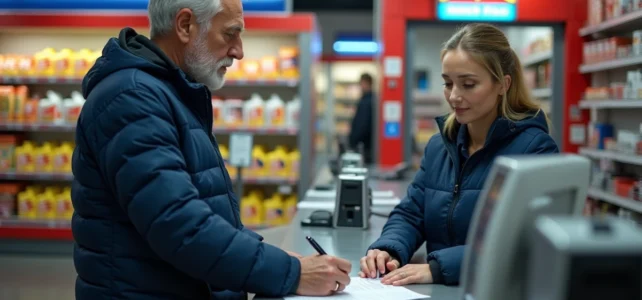
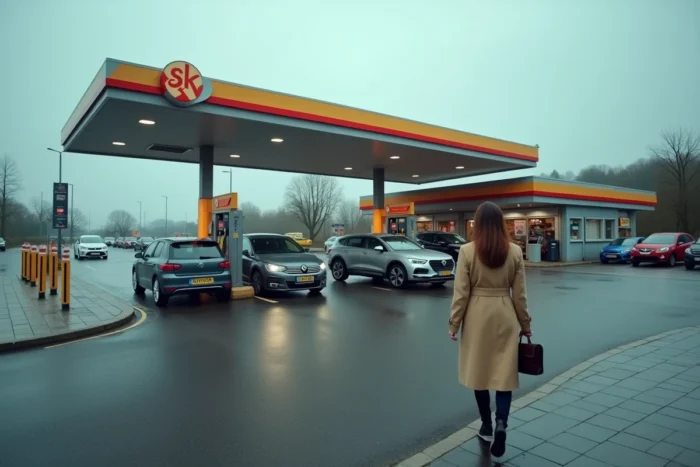
You arrive at the gas station, fill up your tank, and when it’s time to pay, you pull out your checkbook. The cashier hesitates, looks at a colleague, then informs you that checks are no longer accepted. This scene is becoming increasingly common. However, the classic bank check remains a legal means of payment in France, but its acceptance entirely depends on the discretion of each station.
Legal obligation and signage at gas stations: what the law says
No merchant is obliged to accept a check in France. This rule applies to gas stations just like any other business. The Monetary and Financial Code does not classify checks among the means of payment that a professional must accept, unlike cash (within certain limits).
The only requirement concerns informing the customer. If a station refuses checks, it must display this information visibly, usually near the cash register or on the entrance door. Without this signage, the refusal can be contested. In practice, most stations that refuse checks place a “Checks not accepted” sticker next to the payment terminal.
However, there is a specific case. Stations affiliated with a certified management center are obliged to accept bank checks and must indicate this with a dedicated sign. This case mainly concerns independent stations, not large chains. If you spot a sign mentioning affiliation with a certified management center, payment by check at the gas station will be possible without discussion.
Which stations still accept checks for fuel
Large chains like TotalEnergies, E.Leclerc, Carrefour, Auchan, or Intermarché have gradually reduced the acceptance of checks at their stations. Their payment processes focus on bank cards, contactless payments, and professional fuel cards. Checks often no longer even appear on the list of displayed payment methods.
You are more likely to be able to pay by check in the following configurations:
- Independent stations with a cashier, often located in rural or semi-urban areas. These stations sometimes keep checks as a local service for their community.
- Stations affiliated with a certified management center, which are required to accept them.
- Some in-store supermarket stations (not the outdoor kiosks), where traditional checkout may still include checks depending on the store’s policy.
Self-service payment kiosks, found at both TotalEnergies and large retail stations, never accept checks. Only physical checkout makes this payment method feasible. If the station operates solely through kiosks (24/7 automatic stations), checks are automatically excluded.
Concrete protocol: paying by check at the station step by step
When a station accepts checks, the procedure is not the same as for card payments. Several conditions apply, and it’s best to know them before approaching the register.
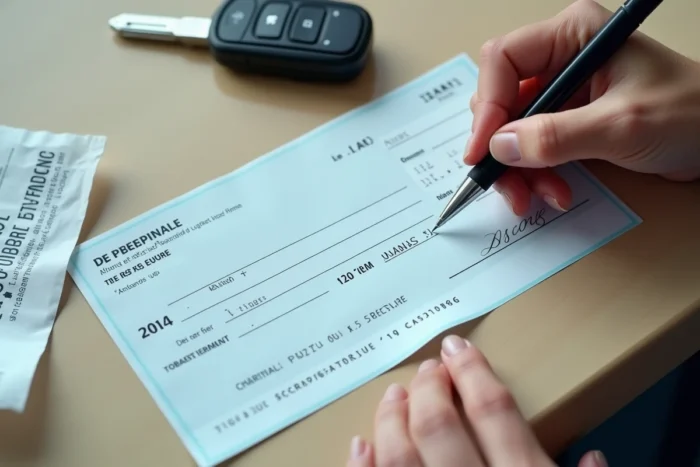
The first requirement concerns the presentation of an ID. The cashier checks that the name on the check matches that of the presented document. A national identity card or passport is accepted, and sometimes a driver’s license, but this is not systematic.
Next is the amount. Some stations apply an internal limit for checks. This limit is not set by law; it falls under the commercial policy of each establishment. It can vary from one station to another, even within the same network. Don’t hesitate to ask before filling up if you plan to pay a large amount.
The typical process is as follows:
- You fill up your tank at the pump, then go to the register (no kiosk).
- The cashier asks for your ID and verifies the match with the check.
- You fill out the check to the order of the station or brand, with the exact amount displayed on the receipt.
- In some cases, the cashier notes your ID number on the back of the check.
The check must be valid. In mainland France, a check can be cashed for 1 year and 8 days after its date of issue. An expired check will be refused.
Bank checks and holiday vouchers: do not confuse
A common confusion arises in online searches. Holiday vouchers (issued by ANCV) and classic bank checks are subject to completely different rules at gas stations.
Holiday vouchers are generally not accepted for fuel. Their use is limited to expenses related to vacations and leisure (accommodation, dining, public transport). Even if some brands accept holiday vouchers in-store, the fuel pump remains excluded from this scope in almost all cases.
The classic bank check, however, can be used to pay for fuel if the station accepts it. The two payment methods have neither the same issuer, nor the same legal framework, nor the same conditions of use.
Alternatives when checks are refused at the station
If your usual station no longer accepts checks, several solutions exist. The bank card remains the most common means, including at kiosks. Contactless payment now works in the vast majority of stations in the TotalEnergies network and large retail brands.
For professionals, dedicated fuel cards (offered by several providers) allow for centralizing fleet expenses without using checks or personal cards. These cards work at most station networks in France.
Bank checks at gas stations have become an atypical case, reserved for specific configurations. Before relying on them, a quick call to the intended station or a glance at the signage in the window remains the most reliable reflex.