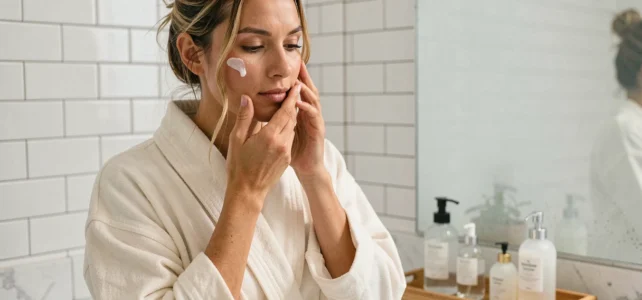
Daily beauty relies on precise biological mechanisms: cellular renewal, balance of the hydrolipid film, collagen production. Understanding these processes allows for the selection of the right actions and avoids unnecessary treatments. The skin, hair, and body respond to cycles that must be respected to achieve lasting radiance without multiplying products.
Hydrolipid Film and Hydration: The Mechanism to Protect
The surface of the skin is covered by a natural emulsion made of water and lipids. This hydrolipid film acts as a barrier against external aggressions and limits insensible water loss. When this barrier is compromised, the skin feels tight, turns red, and ages more quickly.
Facial cleansing is the action that most weakens this protection. A product that is too stripping dissolves the surface lipids and forces the skin to overproduce sebum to compensate. The paradoxical result: skin that is both dehydrated and shiny.
To maintain this balance, several resources detail approaches suitable for each skin type. Notably, on Madame Turban’s beauty site, you can find routines built around this principle of respecting the skin barrier.
Hydration is not limited to applying a cream. It starts from within: sufficient water intake and dietary fatty acids (omega-3, omega-6) directly contribute to the quality of the hydrolipid film. A moisturizing cream does not replace inadequate internal hydration.

Cellular Renewal and Facial Radiance
The epidermis naturally renews itself over a cycle of several weeks. With age, this cycle slows down: dead cells accumulate on the surface, the complexion loses its radiance, and pores appear more visible.
Exfoliation artificially accelerates this process. There are two families:
- Mechanical exfoliants (scrubs, brushes) that detach dead cells through friction, suitable for normal to combination skin but risky for sensitive or reactive skin
- Chemical exfoliants (AHA, BHA, PHA) that dissolve the intercellular cement without friction, with a more uniform action that is better tolerated by fragile skin
- Enzymatic exfoliants (based on papain or bromelain) that digest the proteins of dead cells, the gentlest option for atopic skin
A common pitfall is over-exfoliation. Scrubbing your face every day destroys the protective stratum corneum and causes chronic inflammation. One to two scrubs per week are sufficient for most skin types.
Hair Care: Understanding the Role of Sebum and the Scalp
Hair health is determined at the scalp level, not the lengths. The hair follicle produces sebum that lubricates the hair shaft in its first few centimeters. This sebum is a natural treatment that frequent washing eliminates.
A daily shampoo with an aggressive surfactant (like sulfate) disrupts the sebaceous production of the scalp. The sebaceous gland, stimulated by the lack of lipids, produces more. The vicious cycle sets in: the more you wash, the faster the hair becomes oily.
Spacing shampoos to two or three times a week allows the scalp to regain its natural rhythm. The transition period lasts a few weeks, during which the hair may appear oilier than usual.
Treatments applied to the lengths (masks, oils) only act on the keratinized fiber. They temporarily repair the cuticle damaged by heat or coloring but do not change the quality of the growing hair. The real intervention happens upstream: a diet rich in zinc, iron, and B vitamins.

European Cosmetic Regulation: What Changes for Your Products in 2026
The European Union has profoundly modified cosmetic labeling. The list of declarable allergens increases from 26 to 82 substances with regulation (EU) 2023/1545, applicable to products launched on the market for the first time from July 31, 2026.
In practical terms, a fragrance or cream purchased after this date will display a significantly longer ingredient list. This increased transparency allows allergic individuals to identify risky substances but also requires knowing how to read an INCI label.
Reading an INCI Label After the 2026 Update
The European INCI glossary has been revised by implementing decision (EU) 2025/1175, effective from July 30, 2026. The names of certain ingredients are changing, which can be confusing if you were used to identifying your allergens by their old names.
Another point to watch: the UV filter 4-MBC has been removed from the European market. Products containing this substance can no longer be sold since May 2026. If you have a sunscreen purchased before this date, check its composition.
Daily Beauty Routine: The Order of Actions Matters
The layering of treatments follows a physico-chemical logic: from the most fluid to the thickest, from the most active to the most occlusive. Applying a serum after a rich cream is like pouring water on butter. The serum does not penetrate.
The suitable order in the morning:
- Gentle cleanser (milk, micellar water, or sulfate-free gel) to remove nighttime sebum without stripping
- Concentrated active serum (vitamin C for radiance, hyaluronic acid for hydration) on slightly damp skin
- Moisturizing cream suitable for your skin type, which seals in the serum’s actives
- Sun protection as the last step, even in winter, even on cloudy days
Sun protection remains the most documented anti-aging gesture. UV rays degrade collagen and elastin in a cumulative and irreversible manner. No anti-wrinkle serum can compensate for unprotected daily sun exposure.
In the evening, double cleansing (oil-based then water-based) removes makeup, sunscreen, and pollution particles. At night, the skin enters an active repair phase: this is the time to apply the most concentrated actives (retinol, peptides) that would be degraded by light during the day.
Each skin reacts differently to actives. Introducing only one new product at a time, for a minimum of two weeks, remains the most reliable method to identify what works and what irritates.