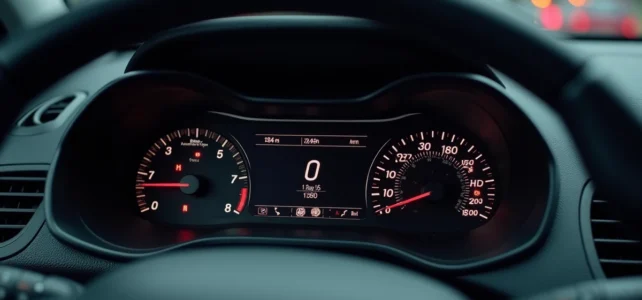
After a battery change or engine reprogramming on the Peugeot 208, the dashboard may display unusual warning lights, disabled functions, or persistent alerts. These symptoms do not all indicate a real failure. Some result from a simple loss of memory in the control units, while others mask a reset issue that could compromise the vehicle’s safety or lead to a re-inspection at the technical control.
Battery voltage and alternator charge: values to measure immediately
The first reflex after any intervention on the electrical circuit is to check two voltage measurements. These readings condition the proper functioning of all onboard control units and the disappearance of erratic warning lights.
| Measurement | Condition | Normal Range | Consequence if out of range |
|---|---|---|---|
| Battery voltage | Engine off, contact off | 12.6 – 12.7 V | Start-Stop inhibited, erratic warning lights |
| Alternator voltage | Engine idling | 13.5 – 14.8 V | Engine, airbag, or STOP light on |
A battery showing less than 12.4 V with the engine off is not sufficiently charged for the BMS (Battery Management System) to allow auxiliary functions. The Start-Stop system, in particular, remains locked as long as the charge is deemed insufficient.
When you need to analyze each Peugeot 208 dashboard to check after intervention, the voltage measurement serves as the starting point that conditions all other checks.
An alternator voltage below 13.5 V with the engine running indicates a faulty charging circuit. In this case, the control units receive unstable power and may generate fault codes that have nothing to do with the reprogramming performed.

Airbag and passive safety warning lights after battery disconnection
The airbag warning light is the most frequently misinterpreted signal after a battery change on the 208. The voltage drop caused by disconnection can store a fault code in the airbag control unit, even if the system is functioning perfectly.
This warning light is not trivial. An illuminated airbag warning light leads to a re-inspection at the technical control, as the restraint system is considered inoperative. It is not enough to wait for it to turn off by itself: on the 208, clearing it usually requires a diagnostic check with an OBD tool.
Differentiating a stored fault from a real failure
A fault that is simply stored disappears after the code is cleared, without reappearing on the next restart. However, if the light comes back on immediately after clearing, the problem is physical: oxidized connector under the seat, damaged seatbelt pretensioner, or faulty impact sensor.
The control procedure consists of three steps:
- Clear the fault code with a compatible PSA diagnostic tool
- Turn off the ignition, wait thirty seconds, then turn the ignition back on
- Observe if the light comes back on within the next two minutes – if it stays off, the fault was purely electronic
Engine reprogramming and fault code P0087 on the 208 GTi
After a reprogramming of the engine mapping, fault code P0087 (common rail pressure too low) may appear on some 208 GTi models. This code raises the question: is it a direct consequence of the reprogramming or a coincidence?
A documented case on a 208 GTi that underwent engine reprogramming shows that code P0087 can result from a weakened fuel pressure sensor, whose tolerance is exceeded by the new mapping values. The reprogramming did not create the problem; it revealed it.
After any reprogramming, the dashboard of the 208 must be monitored over several driving cycles. An orange engine light appearing in the first few kilometers does not automatically indicate a failure of the reprogramming. It may signal:
- An incomplete adaptation of the engine control unit to the new values (PSA ECUs sometimes require several driving cycles to recalibrate injection parameters)
- A sensor at the end of its life being pushed beyond its initial range by the new mapping
- A pre-existing fault masked by the old mapping, which limited performance in the affected area
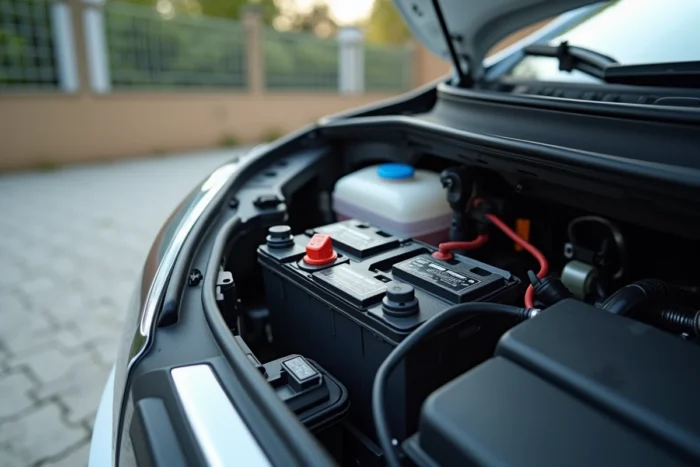
BMS reset and recovery of Start-Stop on Peugeot 208
The BMS of the phase 1 208 raises a recurring question: is it capable of self-learning when installing a new battery, or must it be done at the dealership?
User feedback on forums dedicated to the 208 shows that the BMS does not always automatically recalibrate the parameters of the new battery. The system continues to rely on the profile of the old battery (capacity, internal resistance, charge history), which keeps the Start-Stop disabled despite a new and fully charged battery.
OBD tool: in which cases it becomes essential
Registering the new battery via a compatible PSA OBD tool allows the BMS to be informed about the capacity and exact type of the installed battery (EFB, AGM, standard). Without this declaration, the control unit may interpret the new battery as a degraded battery and limit the charge to preserve it, creating a vicious circle where the Start-Stop remains blocked.
The typical symptom on the 208 is a Start-Stop indicator that flashes three times in green at a stop, then turns off. This behavior indicates that the BMS considers the energy reserve insufficient to guarantee a restart, even when the battery is fully charged.
Red, orange, and combined alert lights: severity hierarchy on the 208
Not all warning lights on the 208 dashboard warrant the same reaction. A red light requires the immediate stop of the vehicle (engine temperature, oil pressure, braking). An orange light allows driving to a diagnostic point, provided engine load is limited.
After a battery change, the most frequently wrongly illuminated lights are the orange engine light, the airbag light, and the tire pressure warning light. None of these three require an immediate stop, but all need a fault code clearing if the cause is purely electronic.
The STOP light, accompanied by a text message on the display, remains the most critical signal. On the 208, it is always accompanied by a braking or overheating alert and should never be ignored, even after a recent electrical intervention.
The distinction between a false warning light post-intervention and a real mechanical fault is based on a simple principle: any light that persists after an OBD clearing indicates a real problem. One that disappears permanently after clearing was just a remnant of the power cut.