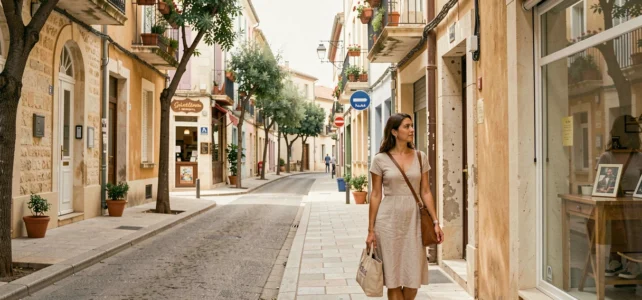
The Grisettes neighborhood, attached to the Croix d’Argent sector in the southwest of Montpellier, has several characteristics that deserve comparison with other sought-after areas of the city. With tramway access, a developing commercial offering, and rising real estate prices, the available data allows us to measure what this neighborhood concretely offers to a future resident, and what it does not guarantee.
Grisettes Compared to Other Green Neighborhoods in Montpellier: Comparative Table
Montpellier has several eco-districts that are officially labeled or claimed as such. Comparing the Grisettes to Port Marianne, Cambacérès, or Ovalie based on concrete criteria helps to situate the neighborhood within the overall offering.
| Criterion | The Grisettes | Port Marianne | Cambacérès | Ovalie |
|---|---|---|---|---|
| Official eco-district label | Yes (Ministry of Housing) | Yes (labeled sub-districts) | Bioclimatic design | Green neighborhood, no official label mentioned |
| Tramway access | Line 2 | Lines 1 and 3 | Line 1 | Line 3 |
| Integrated agripark | Yes, about 20 ha | No (urban parks) | No | No |
| Commercial activity | In development (recent neighborhood hall) | Established | In progress | Limited |
| Price positioning | Above the Montpellier average for some properties | Among the highest in the city | High-end segment | Intermediate |
This table highlights a distinctive point: the Grisettes are the only neighborhood to combine a 20-hectare agripark and an eco-district label. Port Marianne offers more established services, but at a significantly higher price level.
To better understand daily life in the Grisettes neighborhood in Montpellier, one must go beyond just the pricing grid and examine what truly structures commuting, shopping, and schooling.
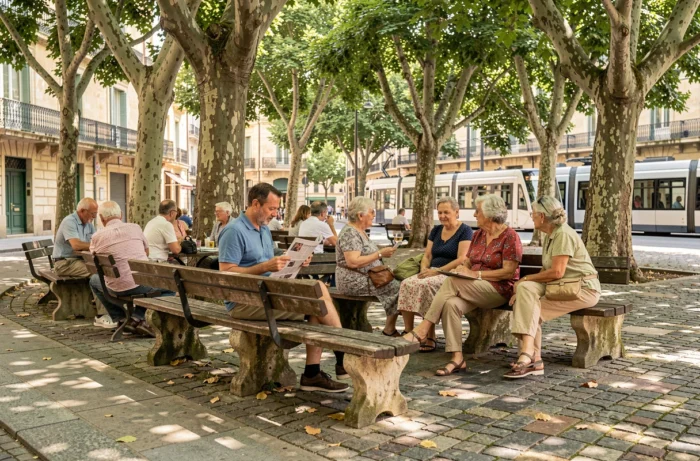
Multimodal Access in the Grisettes: A Neighborhood Less Dependent on Cars
Tram line 2 serves as the structural axis of the neighborhood. Several bus lines complement the network, placing the Grisettes among the best-connected peripheral areas to the city center without a systematic reliance on cars.
This multimodal access was designed from the outset of the neighborhood. The city of Montpellier initiated the development of the Grisettes in direct connection with the route of the second tram line, backing it with a urban density calibrated around public transport.
In contrast, neighborhoods located further south or west of the metropolis (residential Lattes, certain sectors of Castelnau-le-Lez) remain more dependent on cars for daily commutes. This difference impacts the mobility budget of a household moving in.
Agripark and Beethoven School Group: Two Facilities That Change Daily Life
The agripark of Mas Nouguier, acquired by the city, occupies about twenty hectares directly bordering the neighborhood. It is not just a simple landscaped park. Vines have been uprooted and replaced with new plantings, and the space is open to the public with an agricultural vocation maintained.
For a family, this proximity to a cultivated space alters the perception of the living environment. The Grisettes do not resemble a generic new neighborhood placed on the outskirts. The agripark creates a transition between the city and the countryside that few Montpellier sectors can claim.
The Beethoven school group, a key public facility in the neighborhood, prevents families from having to enroll their children in another area. This is a criterion often underestimated when moving: the presence of a neighborhood school reduces travel times and facilitates daily family organization.
Recent Commercial Activity
The neighborhood is gaining autonomy with the arrival of new brands and a covered market-type hall. The Plaza hall, recently mentioned in the local press, illustrates this commercial upgrade. The Grisettes are gradually transitioning from a residential area to a neighborhood with its own local shops.
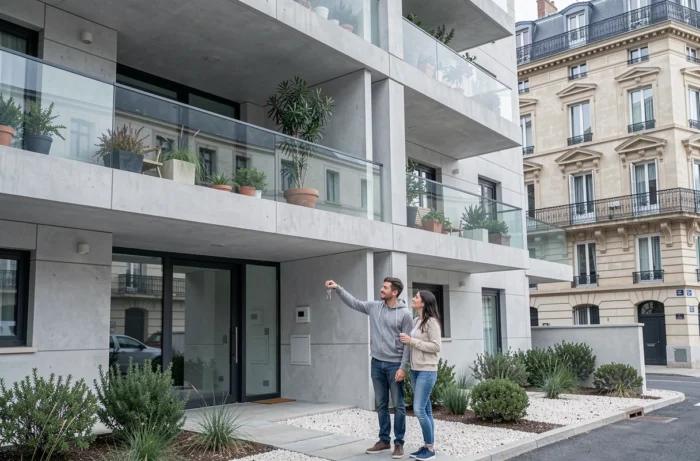
Real Estate Prices in the Grisettes: A Quality-Price Ratio to Nuance
Recent listings show that some properties in the Grisettes are positioned above the Montpellier average. This observation may be surprising for a peripheral neighborhood, but it can be explained by the concentration of new labeled programs and sustained demand in this sector.
For a buyer, three elements deserve consideration before signing:
- The price per square meter for new properties in the Grisettes incorporates the environmental standards of the eco-district label, which elevates it compared to older properties in other areas of Montpellier
- The rental pressure on the neighborhood is real, which may reassure an investor but reduces negotiation margins for an owner-occupier
- The Croix d’Argent sector as a whole remains cheaper than Port Marianne or the historic center, but the Grisettes are driving prices up in the sector
Conversely, a buyer comparing with peripheral municipalities like Lattes or Castelnau-le-Lez will find price levels that are sometimes comparable, with very different neighborhood profiles.
Safety in the Grisettes: A Recent Point of Vigilance
Residents of certain residential complexes in the neighborhood have recently called on the mayor of Montpellier regarding a perceived deterioration of the tranquility. A petition and a letter have been sent to the municipality, relayed by the local press.
This signal does not make the Grisettes a neighborhood to avoid. It indicates that the rapid growth of the sector, with the arrival of many new residents, generates occasional tensions that the city will need to address. Any future resident would benefit from inquiring about the specific residence they are targeting rather than the neighborhood as a whole.
The Grisettes remain a sector where the combination of tramway, agripark, and labeled eco-district constitutes a rare offering in Montpellier. The main trade-off is between a distinctive living environment and prices that are no longer those of a classic peripheral neighborhood.